Bees are unique as 'farmed' animals in that they have no constraints placed on their movements: they cannot be contained by fences, walls or hedges. For this reason, they must and will forage where they please.
Honeybees typically fly up to five kilometers from their hive in search of food. Their instinct for efficient use of fuel dictates that they will only fly as far as necessary to collect what they consider to be high quality food, and it is well known that they have a preference for certain types of flowers, and that they will make use of whatever is available to them, within their range, that offers significantly greater returns in terms of calories and nutritional content than they expend in its collection.
Thus, honeybees will fly over apple blossom, dandelions and clover to get to a flowering field of oilseed rape that is within their flying range, because of the high concentration of nectar and pollen that such a crop offers. This does not mean that OSR is necessarily more nutritionally beneficial to bees than apple, dandelion or clover flowers, but simply that they find a field of such a crop irresistible because of the sheer quantity of food that it represents.
If we are to retain the decreasing number of commercial beekeepers willing and able to provide honey-production and pollination services, and if we are to continue growing field crops that depend on bees for pollination, then their needs must be respected and planned for. One such need is to be able to produce honey that is recognised as being pure and unadulterated, and thus free from any contaminants, including systemic insecticides that are present by design in many GM crops. Such insecticides may or may not be intrinsically lethal to bees, but may have as-yet-unproven sub-lethal side-effects, particularly on the bees' navigation systems. They may also have digestive or oxidation breakdown products that could be toxic to bees, and/or may prove to have harmful effects on the human consumers of their products, which also include pollen, beeswax and propolis.
Commercial beekeeping in Britain has become increasingly marginal over the last 50 years, largely due to the unregulated importation of cheap honey from China, the Indian sub-continent and eastern Europe. One beekeeper of my aquaintance, who runs 1500 hives with only two men, told me recently that in the 1960s it took one ton of honey to pay a man's wages for the year, while now it takes six tons. While some commercial beekeepers provide mobile pollination services, and some others move their hives to moorland locations for the heather honey crop, escalating transport costs have rendered large-scale hive movements less and less profitable.
There are an estimated 50,000 amateur beekeepers in Britain, whose bees perform countless millions of pollination operations every day during the growing season. While they do not count towards our GDP, they do represent a considerable, unpaid contribution towards the welfare of our parks and gardens, as well as the production of both wild and domestic fruit and vegetables. These amateur beekeepers have their hives mostly in fixed positions and would not be able to move them in order to avoid their bees foraging on nearby GM crops.
I would suggest that, just as extensive sheep farmers will want to know what their animals are feeding on, and to have the opportunity to prevent them ingesting any potentially toxic material, that beekeepers must also have the right to know that their charges are foraging on flowers that will not cause them harm. Until peer-reviewed, long-term studies are produced that demonstrate conclusively that GM crops present no dangers to bees, and produce no toxic breakdown products as a result of being consumed by bees, that any GM-contaminated crops be identified and their location clearly signposted so that beekeepers are not subjected to the hazards they potentially represent.
Saturday, October 01, 2011


Monday, April 25, 2011
What Is Wrong With Modern Beekeeping?
Text of a talk presented at the Spring Convention of the British Bee Keepers Association, April 15 2011
Some speakers begin with a foreword; I shall begin with a forewarning: this talk may offend some people.
It will offend creationists, who choose to ignore the evidence for evolution; it will offend fundamentalists, who believe that the only purpose of the so-called 'lower forms of life' is to serve mankind; it will offend those who believe that the Reverend Langstroth was revealing God's word when he designed his movable frame hive; and it will offend those who choose to ignore the paradigm shift that is occurring today among people who have woken up to the damage being done to our planet by the corporations that seek to own it.
The title of this talk - What Is Wrong With Modern Beekeeping? - begs a question: is there something wrong with modern beekeeping?
My contention is that there is indeed much that is wrong with it, and that the root of the problem lies in the anthropocentric, pre-Darwinian belief that we are in charge: that humankind has a God-given right to dominion over all other forms of life, and that animals – including bees – were created purely to serve us.
'Modern' beekeeping can be said to have begun in the year 1852 – the year that Langstroth patented his hive. He did so, it should be noted, with the express purpose of making the commercial exploitation of bees a practical possibility.
1852 was also the year that Langstroth published his book, The Hive and the Honeybee, in which we find the following passage:
“The Creator intended the bee for the comfort of man, as truly as he did the horse or the cow.
The honey bee was... created not merely with the ability to store up its delicious nectar for its own use, but with certain properties which fitted it to be domesticated, and to labor for man, and without which, he would no more have been able to subject it to his control, than to make a useful beast of burden of a lion or a tiger.”
Which is to say that, according to this creed, not only were bees created in order to provide us with something sweet, but that they were allocated 'certain properties' that enable us to domesticate them. In those days, most people shared Langstroth's belief that 'The Creator intended the bee for the comfort of man' and that its purpose was to 'labor for man'.
And yet, unbeknown to the Reverend Langstroth, some twenty years earlier, a little ship had set sail from Plymouth harbour on a five-year voyage that was to change our understanding of the world forever. That ship was The Beagle, and just seven years after Langstroth completed his book, Charles Darwin published The Origin of Species.
That was over 150 years ago. And yet, even today, despite Darwin's insights having been tested over and over by science; despite overwhelming evidence that all life is interdependent; despite irrefutable proof of the consequences of worldwide destruction of habitat and the poisoning of our life-giving soil by profit-driven corporations; despite all that, we see people still behaving as if they had God-given dominion over life on earth.
And what of so-called 'modern beekeeping'? Has it fully embraced the post-Darwinian world? Or does it still operate from that old testament, fundamentalist paradigm? Are we – as appears to be the case - still teaching people how to 'manage' and 'control' bees, when we should be teaching them how to observe, listen to and work with the bees?
We know that honeybees are finely adapted to their environment, from having evolved closely - over many millions of years – alongside the flowering plants on which they depend.
We know that the plants themselves depend on bees and other insects for pollination, and we know that the well-being of our planet and all life upon it depends on a healthy soil, nurturing a flourishing, diverse range of plants, which feed insects, then birds and fish, then mammals, carnivores and ultimately ourselves.
We know all that. And yet we have allowed our agricultural system to fall into the hands of those whose only concern is their own profit, and who care nothing for soil health or biodiversity. Their only concern is for increased sales of soil-destroying artificial fertilizers, herbicides that poison our water and insecticides that kill an entire sector of the food chain, including - and most importantly - our bees.
Here's what an American writer and beekeeper, Kirk Webster, said in 2006:
“All of American agriculture is suffering terribly now from trying to force a process based on the workings of Nature into an industrial and business model. The ability to produce quality food has been abandoned in the quest to grow ever larger quantities of cheap, low quality commodities from our vast resources of soil and water. Because human health depends very largely on having continuous access to quality food, almost all Americans are suffering as a result of this process.“
And it's not just Americans.
We can no longer pretend that the old, pre-Darwinian paradigm has any validity: we do not have - and we never have had - dominion over life on earth. Only a fool would leave a species like ours in charge of a planet.
We are only a part of life on earth, far less numerous than some, and yet we are by far the most destructive species ever to have lived here and we show little sign of reforming any time soon.
What is worse is that we seem to be incapable - as a species - of learning from our mistakes. Few people would say that war is a civilized way of settling disputes, and yet there has never been a time in recorded history when some part of the human race has not been at war with some other part. And most of those wars were and are based on differences of religious belief, with absolutely no hard evidence to back up either side.
In a similar way, we have bought into the corporate notion that we are somehow 'at war with nature', and that any living thing - be it plant or insect - that appears to stand in the way of the efficient production of shiny, cheap and tasteless supermarket food must be the enemy and therefore must be controlled and, if possible, eliminated.
The passage I quoted earlier from Langstroth's The Hive and the Honeybee illuminates the exact point in history when the Old Testament doctrine that 'bees are subject to our will' was cemented into beekeeping lore.
And there it remains to this day as a pervasive, if largely unstated belief. It finds expression in the teaching programmes of bee keepers' associations, where there is an underlying presumption that the only acceptable reason for keeping bees is the production of the maximum quantity of honey.
Roger Morse, in his 'Complete Guide To Beekeeping', flatly states that, 'The goal in beekeeping should be honey production...' and that 'Only a beekeeper who produces as much honey as possible thoroughly understands bees, beekeeping and bee biology.'
This attitude of nature-dominating, production-driven beekeeping is the legacy of Langstroth and his disciples that continues to be preached to this day.
It sees a bee colony as a mere commodity for making profit; the hive as a machine for making honey, rather than the home of the bees. It regards weekly disturbance of the colony, and the addition of toxic chemicals as normal.
It regards the bees merely as units of production, that are expendable and that can be killed, replaced, traded, or transported at will.
It pays little heed to the needs of other local species or the local ecology, while being responsible for importing of varroa, viruses, nosema and a host of pathogens and parasites from around the world.
Thus, the typical response by 'old hands' to new beekeepers, who express shock at the considerable investment in new equipment required of them: “You can always recoup your investment by selling honey!”
And so the innocent beginner becomes locked into the 'bee-farming' mentality, and what was once in their mind to become an engaging hobby, turns instantly into a small business, with a profit-and-loss account and bees now regarded as stock with a monetary value, instead of wild creatures fleetingly in our care.
That commercial exploitation of bees has played a large part in the problems we now face is clear, but that does not necessarily mean that all commercial beekeeping activity is destructive.
I recently had a conversation with a beekeeper, who, with one other man, runs 1500 hives. His principles include minimal interference, minimal mite treatment and little movement of hives. He does not inspect every 8 days looking for queen cells, nor does he import artificially inseminated queens: he has, over many years, created the conditions for the bees to interbreed and create an ecotype that is adapted to his local conditions. I know of another commercial beekeeper in another part of the country who operates in a very similar way.
This methodology has a lot in common with post-modern, 'natural beekeeping' philosophy, guided by a principle, which I hold to be self-evident, that bees know best what is good for them and that our job is to listen, to watch and to follow their lead.
Contrast this with the teachings of the disciples of Langstroth, who insist that they know best when a queen should be replaced, which strain of bee she should be replaced with, and what size cells she should be allowed to lay into. And then they wonder why their honeybees appear to suffer from parasites, 'mystery disappearances' and diseases that were virtually unknown before the advent of the movable-frame hive, re-cycled wax foundation and chemical medications.
Of course, beekeepers are not entirely to blame for the ills of bees: much of the responsibility for the mess we now find ourselves in must be laid squarely at the door of the agri-chemical industry, whi began by selling to farmers the weapons of chemical warfare left over from the First World War, and ever since have systematically poisoned our agricultural land, our water supplies and our wild places, deriving massive profits from peddling their toxic wares, while infiltrating and disabling all attempts to regulate their activities.
If proof were needed of the fatal power of human greed over rational, long-term thinking, one would not need to look further than the corporate entities of Monsanto, Bayer, BASF, Syngenta and their like to find it.
Nevertheless, beekeepers must accept their share of the blame for perpetuating the notion that all ills can be cured using the right 'magic bullet' treatment, be it prophylactic antibiotics, pyrethroid miticides or pollen substitutes. No sooner does a disease appear, than beekeepers are reaching for the latest bottle of medicine, with little thought for the possible long-term consequences.
Contrary to what we are often told, bee diseases made a serious impact as a direct result of the proliferation of intensive, commercial beekeeping, during the half century following the introduction of Langstroth's hive.
Here's what the American beekeeper C P Dadant wrote in 1920:
"If anyone had asked us, twenty years ago, how much trouble might be expected from bee-diseases, we should probably have shrugged our shoulders and answered that they were very insignificant and hardly worthy of notice. For forty years after we began beekeeping the only disease we saw in the apiary was diarrhoea... from which the bees suffered more or less after a protracted winter, especially when their food was not of the best... Foul brood, in either of its two forms was entirely unknown to us. In 1903 the writer had to go as far away as Colorado to be able to see some rare samples of it... It was not until the spring of 1908 that we found it among our bees..."
Just a few years later in 1928, this explanation of the sudden increase in bee diseases was offered by a British beekeeper, A Gilman, in his book 'Practical Bee Breeding'
"...disease is an expression of lowered vitality ...and simultaneously with increased fecundity there has been an extraordinary increase of disease. Their connection may be denied, but when we find a similar occurrence taking place with other livestock which we know to have been pushed for super-production, we consider the matter far more than a mere coincidence."
He goes on:
"...the increase of diseases has occurred principally in those countries where modern methods of breeding have prevailed. In America, brood diseases became so devastating as to call for legislation... on the continent of Europe, apiarists have been troubled with Nosema disease...
we had Isle of Wight disease, which so decimated apiaries all over the country that we had to resort to foreign bees for re-stocking purposes."
Gilman went on to draw this conclusion about 'modern beekeeping':
"...the only conclusion to which one can come, is that the principles on which the whole structure of modern apiculture are based must be at fault, in either one or more important directions."
Many years later, when the Varroa mite appeared in Europe as a direct result of the international bee trade, the treatment of choice was a synthetic pyrethroid, to which, in just a few years, the mites inevitably and entirely predictably developed immunity. Our interventions, combined with the effects of (BBKA-endorsed) pyrethroids concurrently being applied to farmland, actually created the conditions in which the mite could quickly evolve resistance to treatment.
As a direct consequence of this short-term 'magic-bullet' thinking, we now have mites that are substantially more difficult to kill.
So, how might we go about putting things right?
Firstly, we need to look at our underlying attitudes to bees.
Rather than seeking to dominate and control them, we need to respect them: after all, they have been around for many millions of years longer than we have.
We need to acknowledge that here are other legitimate reasons for keeping bees, apart from a desire to extract the maximum yield of honey from them. They are intrinsically valuable, simply for their part in nature. Many people want to keep a hive or two just to have them around, and have no desire to rob them of their honey.
Bees have evolved alongside the flowering plants and have become intimately adapted to them, as the plants have to the bees. We cannot think of bees as separate from plants: they are part of each other and they depend on each other for their very existence.
What we do to flowering plants, we do to bees. If we poison the plants, we poison the bees. If we coat the seeds of our food crops with toxins - such as Bayer's Clothianidin - and those toxins are taken up by plants to become part of their reproductive system, then we are certainly poisoning the bees and all other insects that come into contact with those plants. Not only that, but these systemic insecticides remain in the soil for many years, killing beneficial insects along with the so-called pests. They are taken up by other plants, including those decorative wild flower borders sown around crop fields by well-meaning farmers who think they are helping the bees. Wild flowers will take up the same toxic chemicals and will become lethal to bees in just the same way.
Dr. Jeff Pettis, research leader at the USDA-ARS Bee Research Laboratory in Beltsville, Maryland, USA, spoke to Members of Parliament in April 2011 about the subject of threats to bees, saying:
“The reason I am conducting research on the neonicotinoid group is that they have a new route of exposure to bees, through pollen and nectar, and I continue to be concerned about their potential negative impacts on pollinators.”
He also said that it wasn't just one factor that was responsible for the decline in bee health:
“I think there's more of what I call the 3-P principle – poor nutrition, pesticides and pathogens. Those three things are interacting greatly. Nutrition is the foundation of good bee health, and certainly there's some pesticide exposure going on, but it varies widely over time and space. And the pathogens in my opinion are often acting secondarily. But it's the interaction of these three. You get three of them lined up then surely you'll have bees in poor health. Even the combination of any two could be problematic.”
So, poor nutrition, pesticides and pathogens: the first two of those three are tied to modern, chemical agriculture: poor nutrition being a consequence of monocultured crops and the consequent reduction in biodiversity.
The damaging effects of pathogens are likely to be exacerbated by poor nutrition and pesticides combining forces to weaken the bees' immune systems.
Pathogens are also transported around the world by the international bee trade. Banning all imports of bees into the UK would go some way towards stopping this locally, but we have to recognize that viruses are already everywhere, waiting for their opportunity to grow and spread. While we support toxic agriculture, we are making it easier for them to do so.
We urgently need to radically reform our agricultural system, so that it is not dependent on artificial fertilizers, herbicides and insecticides.
The BBKA should be supporting the organic movement, which is working to develop efficient systems of food production without the use of toxic chemicals. Instead, they have chosen to side with the pesticide industry.
A charity that claims to have the interests of bees and beekeeping at heart should never put itself in a position where it is under the influence of businesses whose purpose is to sell insecticides that kill bees. It is the equivalent of a cancer research charity being controlled by a tobacco company, or a brewery sponsoring Alcoholics Anonymous.
Secondly, amateurs should not be forced to mimic professionals.
When a newcomer turns up at her first bee keepers' association meeting, with the innocent notion that she wishes to keep a couple of hives at the bottom of her garden, she should not be forced to invest hundreds of pounds in hives and equipment that was designed for commercial beekeeping, and that may be too heavy for her to lift when full of bees and honey. Neither should the justification for such expense on ludicrously unsuitable kit be justified by telling her that she needs to become business-minded and sell her honey in order to pay for it.
And in case you think I am being disingenuous in using the feminine gender to make my case, I can tell you that every single course I ran during 2010 had a majority of female participants, and one was comprised entirely of women. When I started beekeeping at the turn of the century, female beekeepers were a rarity, and women's roles at beekeeping meetings were largely restricted to serving tea and cakes.
Beekeeping has been a male preserve for too long, in my opinion, and it is time that women were welcomed back. They were the first victims of the Langstroth hegemony: there were plenty of women in beekeeping in the days of skeps, and the top bar hive is now making it possible for them to return. I have had numerous emails from women thanking me for introducing them to a system of beekeeping that does not require them to lift 50-pound boxes.
We need to consider other types of hive for use by back-garden beekeepers: Nationals and Langstroths do not suit everyone.
Thirdly, we need to look at modern beehives and beekeeping practices from the point of view of our bees.
The Langstroth hive and all of its imitations, including the British National hive, make it relatively easy for beekeepers to interfere with bees and shuffle their combs like a deck of cards, but they do little or nothing to support the natural lives of the bees.
Hive walls are absurdly thin, and do little to help bees regulate their temperature while being easily penetrated by woodpeckers. Honey supers and brood boxes, when full are heavier than most people can safely lift, resulting in back pain and hernias – commonplace among commercial beekeepers. Frames are fragile, prone to being glued together by propolis, and create useful hiding places for the wax moth, while bearing almost no resemblance to the shape that bees choose to build their natural combs. Drones are suppressed by the use of uniform, over-sized foundation, which is recycled along with the toxins it accumulates from pesticides applied both inside and outside the hive. Queens are routinely imported, artificially inseminated, marked, clipped and replaced.
Brood combs are re-used too many times, contributing to the recurrence of disease; swarm cells are hacked out unthinkingly; medications and pest treatments are tossed in more-or-less at a whim.
All these practices are routine even among experienced beekeepers and are often taught as gospel to beginners. They all derive from the same attitude: we know better than the bees.
All these practices need to be examined and questioned: there should be no sacred cows in beekeeping.
There is a strong and growing movement in this country towards more 'natural' beekeeping, which the BBKA has so far failed to acknowledge, presumably in the hope that it will just go away.
'Natural beekeepers' use no synthetic chemicals in their hives and follow less invasive practices. They put the welfare of their bees above honey production targets, and only take honey when the bees can easily spare it. They use hives that help the bees conserve heat, and open them infrequently. They observe, they listen, and they act sparingly and with care.
Natural beekeepers may not yet have all the answers to the welfare of bees, but at least they are asking the right questions.
As I see it, our main job as bee keepers, or bee guardians, or bee herders, or whatever we choose to call ourselves, is to to be observant and to understand our bees to the best of our ability. We cannot fully enter into their world, but we have the opportunity to gain a greater appreciation of it.
And once we begin to understand how intimately embedded they are in the natural world, and what sensitive indicators they are of disturbances therein, we may begin to develop a deep appreciation of the interconnectedness of all living things. And that leads us inevitably to the conclusion that we have a responsibility towards – not only the bees – but towards everything that walks on the earth and flies in the air and shares this precious planet with us.
So yes – I think there is a great deal wrong with modern beekeeping. Much of it can be put right before it is too late, but it will require long-term, strategic thinking and inspired leadership. Sadly, I see little evidence of either among our politicians or the current beekeeping priesthood.
But I do have faith in the next generation of beekeepers: those who have come to the craft motivated by a passion for nature and an instinctive recognition of what is good for the long-term. They know what needs to be done, and I believe they will do it.
They may take their inspiration from Bolivia, which is set to pass a law granting all of nature equal rights to humans. According to a newspaper report, “The Law of Mother Earth redefines the country's rich mineral deposits as "blessings" and is expected to lead to radical new conservation and social measures to reduce pollution and control industry.
[Bolivia] will establish 11 new rights for nature. They include: the right to life and to exist; the right to continue vital cycles and processes free from human alteration; the right to pure water and clean air; the right to balance; the right not to be polluted; and the right to not have cellular structure modified or genetically altered.”
Vice-President Alvaro García Linera is quoted as saying, "It makes world history. Earth is the mother of all. It establishes a new relationship between man and nature, the harmony of which must be preserved as a guarantee of its regeneration."
That is the kind of thinking we need more of, right now, in politics and in beekeeping.
Philip Chandler
April 2011
Some speakers begin with a foreword; I shall begin with a forewarning: this talk may offend some people.
It will offend creationists, who choose to ignore the evidence for evolution; it will offend fundamentalists, who believe that the only purpose of the so-called 'lower forms of life' is to serve mankind; it will offend those who believe that the Reverend Langstroth was revealing God's word when he designed his movable frame hive; and it will offend those who choose to ignore the paradigm shift that is occurring today among people who have woken up to the damage being done to our planet by the corporations that seek to own it.
The title of this talk - What Is Wrong With Modern Beekeeping? - begs a question: is there something wrong with modern beekeeping?
My contention is that there is indeed much that is wrong with it, and that the root of the problem lies in the anthropocentric, pre-Darwinian belief that we are in charge: that humankind has a God-given right to dominion over all other forms of life, and that animals – including bees – were created purely to serve us.
'Modern' beekeeping can be said to have begun in the year 1852 – the year that Langstroth patented his hive. He did so, it should be noted, with the express purpose of making the commercial exploitation of bees a practical possibility.
1852 was also the year that Langstroth published his book, The Hive and the Honeybee, in which we find the following passage:
“The Creator intended the bee for the comfort of man, as truly as he did the horse or the cow.
The honey bee was... created not merely with the ability to store up its delicious nectar for its own use, but with certain properties which fitted it to be domesticated, and to labor for man, and without which, he would no more have been able to subject it to his control, than to make a useful beast of burden of a lion or a tiger.”
Which is to say that, according to this creed, not only were bees created in order to provide us with something sweet, but that they were allocated 'certain properties' that enable us to domesticate them. In those days, most people shared Langstroth's belief that 'The Creator intended the bee for the comfort of man' and that its purpose was to 'labor for man'.
And yet, unbeknown to the Reverend Langstroth, some twenty years earlier, a little ship had set sail from Plymouth harbour on a five-year voyage that was to change our understanding of the world forever. That ship was The Beagle, and just seven years after Langstroth completed his book, Charles Darwin published The Origin of Species.
That was over 150 years ago. And yet, even today, despite Darwin's insights having been tested over and over by science; despite overwhelming evidence that all life is interdependent; despite irrefutable proof of the consequences of worldwide destruction of habitat and the poisoning of our life-giving soil by profit-driven corporations; despite all that, we see people still behaving as if they had God-given dominion over life on earth.
And what of so-called 'modern beekeeping'? Has it fully embraced the post-Darwinian world? Or does it still operate from that old testament, fundamentalist paradigm? Are we – as appears to be the case - still teaching people how to 'manage' and 'control' bees, when we should be teaching them how to observe, listen to and work with the bees?
We know that honeybees are finely adapted to their environment, from having evolved closely - over many millions of years – alongside the flowering plants on which they depend.
We know that the plants themselves depend on bees and other insects for pollination, and we know that the well-being of our planet and all life upon it depends on a healthy soil, nurturing a flourishing, diverse range of plants, which feed insects, then birds and fish, then mammals, carnivores and ultimately ourselves.
We know all that. And yet we have allowed our agricultural system to fall into the hands of those whose only concern is their own profit, and who care nothing for soil health or biodiversity. Their only concern is for increased sales of soil-destroying artificial fertilizers, herbicides that poison our water and insecticides that kill an entire sector of the food chain, including - and most importantly - our bees.
Here's what an American writer and beekeeper, Kirk Webster, said in 2006:
“All of American agriculture is suffering terribly now from trying to force a process based on the workings of Nature into an industrial and business model. The ability to produce quality food has been abandoned in the quest to grow ever larger quantities of cheap, low quality commodities from our vast resources of soil and water. Because human health depends very largely on having continuous access to quality food, almost all Americans are suffering as a result of this process.“
And it's not just Americans.
We can no longer pretend that the old, pre-Darwinian paradigm has any validity: we do not have - and we never have had - dominion over life on earth. Only a fool would leave a species like ours in charge of a planet.
We are only a part of life on earth, far less numerous than some, and yet we are by far the most destructive species ever to have lived here and we show little sign of reforming any time soon.
What is worse is that we seem to be incapable - as a species - of learning from our mistakes. Few people would say that war is a civilized way of settling disputes, and yet there has never been a time in recorded history when some part of the human race has not been at war with some other part. And most of those wars were and are based on differences of religious belief, with absolutely no hard evidence to back up either side.
In a similar way, we have bought into the corporate notion that we are somehow 'at war with nature', and that any living thing - be it plant or insect - that appears to stand in the way of the efficient production of shiny, cheap and tasteless supermarket food must be the enemy and therefore must be controlled and, if possible, eliminated.
The passage I quoted earlier from Langstroth's The Hive and the Honeybee illuminates the exact point in history when the Old Testament doctrine that 'bees are subject to our will' was cemented into beekeeping lore.
And there it remains to this day as a pervasive, if largely unstated belief. It finds expression in the teaching programmes of bee keepers' associations, where there is an underlying presumption that the only acceptable reason for keeping bees is the production of the maximum quantity of honey.
Roger Morse, in his 'Complete Guide To Beekeeping', flatly states that, 'The goal in beekeeping should be honey production...' and that 'Only a beekeeper who produces as much honey as possible thoroughly understands bees, beekeeping and bee biology.'
This attitude of nature-dominating, production-driven beekeeping is the legacy of Langstroth and his disciples that continues to be preached to this day.
It sees a bee colony as a mere commodity for making profit; the hive as a machine for making honey, rather than the home of the bees. It regards weekly disturbance of the colony, and the addition of toxic chemicals as normal.
It regards the bees merely as units of production, that are expendable and that can be killed, replaced, traded, or transported at will.
It pays little heed to the needs of other local species or the local ecology, while being responsible for importing of varroa, viruses, nosema and a host of pathogens and parasites from around the world.
Thus, the typical response by 'old hands' to new beekeepers, who express shock at the considerable investment in new equipment required of them: “You can always recoup your investment by selling honey!”
And so the innocent beginner becomes locked into the 'bee-farming' mentality, and what was once in their mind to become an engaging hobby, turns instantly into a small business, with a profit-and-loss account and bees now regarded as stock with a monetary value, instead of wild creatures fleetingly in our care.
That commercial exploitation of bees has played a large part in the problems we now face is clear, but that does not necessarily mean that all commercial beekeeping activity is destructive.
I recently had a conversation with a beekeeper, who, with one other man, runs 1500 hives. His principles include minimal interference, minimal mite treatment and little movement of hives. He does not inspect every 8 days looking for queen cells, nor does he import artificially inseminated queens: he has, over many years, created the conditions for the bees to interbreed and create an ecotype that is adapted to his local conditions. I know of another commercial beekeeper in another part of the country who operates in a very similar way.
This methodology has a lot in common with post-modern, 'natural beekeeping' philosophy, guided by a principle, which I hold to be self-evident, that bees know best what is good for them and that our job is to listen, to watch and to follow their lead.
Contrast this with the teachings of the disciples of Langstroth, who insist that they know best when a queen should be replaced, which strain of bee she should be replaced with, and what size cells she should be allowed to lay into. And then they wonder why their honeybees appear to suffer from parasites, 'mystery disappearances' and diseases that were virtually unknown before the advent of the movable-frame hive, re-cycled wax foundation and chemical medications.
Of course, beekeepers are not entirely to blame for the ills of bees: much of the responsibility for the mess we now find ourselves in must be laid squarely at the door of the agri-chemical industry, whi began by selling to farmers the weapons of chemical warfare left over from the First World War, and ever since have systematically poisoned our agricultural land, our water supplies and our wild places, deriving massive profits from peddling their toxic wares, while infiltrating and disabling all attempts to regulate their activities.
If proof were needed of the fatal power of human greed over rational, long-term thinking, one would not need to look further than the corporate entities of Monsanto, Bayer, BASF, Syngenta and their like to find it.
Nevertheless, beekeepers must accept their share of the blame for perpetuating the notion that all ills can be cured using the right 'magic bullet' treatment, be it prophylactic antibiotics, pyrethroid miticides or pollen substitutes. No sooner does a disease appear, than beekeepers are reaching for the latest bottle of medicine, with little thought for the possible long-term consequences.
Contrary to what we are often told, bee diseases made a serious impact as a direct result of the proliferation of intensive, commercial beekeeping, during the half century following the introduction of Langstroth's hive.
Here's what the American beekeeper C P Dadant wrote in 1920:
"If anyone had asked us, twenty years ago, how much trouble might be expected from bee-diseases, we should probably have shrugged our shoulders and answered that they were very insignificant and hardly worthy of notice. For forty years after we began beekeeping the only disease we saw in the apiary was diarrhoea... from which the bees suffered more or less after a protracted winter, especially when their food was not of the best... Foul brood, in either of its two forms was entirely unknown to us. In 1903 the writer had to go as far away as Colorado to be able to see some rare samples of it... It was not until the spring of 1908 that we found it among our bees..."
Just a few years later in 1928, this explanation of the sudden increase in bee diseases was offered by a British beekeeper, A Gilman, in his book 'Practical Bee Breeding'
"...disease is an expression of lowered vitality ...and simultaneously with increased fecundity there has been an extraordinary increase of disease. Their connection may be denied, but when we find a similar occurrence taking place with other livestock which we know to have been pushed for super-production, we consider the matter far more than a mere coincidence."
He goes on:
"...the increase of diseases has occurred principally in those countries where modern methods of breeding have prevailed. In America, brood diseases became so devastating as to call for legislation... on the continent of Europe, apiarists have been troubled with Nosema disease...
we had Isle of Wight disease, which so decimated apiaries all over the country that we had to resort to foreign bees for re-stocking purposes."
Gilman went on to draw this conclusion about 'modern beekeeping':
"...the only conclusion to which one can come, is that the principles on which the whole structure of modern apiculture are based must be at fault, in either one or more important directions."
Many years later, when the Varroa mite appeared in Europe as a direct result of the international bee trade, the treatment of choice was a synthetic pyrethroid, to which, in just a few years, the mites inevitably and entirely predictably developed immunity. Our interventions, combined with the effects of (BBKA-endorsed) pyrethroids concurrently being applied to farmland, actually created the conditions in which the mite could quickly evolve resistance to treatment.
As a direct consequence of this short-term 'magic-bullet' thinking, we now have mites that are substantially more difficult to kill.
So, how might we go about putting things right?
Firstly, we need to look at our underlying attitudes to bees.
Rather than seeking to dominate and control them, we need to respect them: after all, they have been around for many millions of years longer than we have.
We need to acknowledge that here are other legitimate reasons for keeping bees, apart from a desire to extract the maximum yield of honey from them. They are intrinsically valuable, simply for their part in nature. Many people want to keep a hive or two just to have them around, and have no desire to rob them of their honey.
Bees have evolved alongside the flowering plants and have become intimately adapted to them, as the plants have to the bees. We cannot think of bees as separate from plants: they are part of each other and they depend on each other for their very existence.
What we do to flowering plants, we do to bees. If we poison the plants, we poison the bees. If we coat the seeds of our food crops with toxins - such as Bayer's Clothianidin - and those toxins are taken up by plants to become part of their reproductive system, then we are certainly poisoning the bees and all other insects that come into contact with those plants. Not only that, but these systemic insecticides remain in the soil for many years, killing beneficial insects along with the so-called pests. They are taken up by other plants, including those decorative wild flower borders sown around crop fields by well-meaning farmers who think they are helping the bees. Wild flowers will take up the same toxic chemicals and will become lethal to bees in just the same way.
Dr. Jeff Pettis, research leader at the USDA-ARS Bee Research Laboratory in Beltsville, Maryland, USA, spoke to Members of Parliament in April 2011 about the subject of threats to bees, saying:
“The reason I am conducting research on the neonicotinoid group is that they have a new route of exposure to bees, through pollen and nectar, and I continue to be concerned about their potential negative impacts on pollinators.”
He also said that it wasn't just one factor that was responsible for the decline in bee health:
“I think there's more of what I call the 3-P principle – poor nutrition, pesticides and pathogens. Those three things are interacting greatly. Nutrition is the foundation of good bee health, and certainly there's some pesticide exposure going on, but it varies widely over time and space. And the pathogens in my opinion are often acting secondarily. But it's the interaction of these three. You get three of them lined up then surely you'll have bees in poor health. Even the combination of any two could be problematic.”
So, poor nutrition, pesticides and pathogens: the first two of those three are tied to modern, chemical agriculture: poor nutrition being a consequence of monocultured crops and the consequent reduction in biodiversity.
The damaging effects of pathogens are likely to be exacerbated by poor nutrition and pesticides combining forces to weaken the bees' immune systems.
Pathogens are also transported around the world by the international bee trade. Banning all imports of bees into the UK would go some way towards stopping this locally, but we have to recognize that viruses are already everywhere, waiting for their opportunity to grow and spread. While we support toxic agriculture, we are making it easier for them to do so.
We urgently need to radically reform our agricultural system, so that it is not dependent on artificial fertilizers, herbicides and insecticides.
The BBKA should be supporting the organic movement, which is working to develop efficient systems of food production without the use of toxic chemicals. Instead, they have chosen to side with the pesticide industry.
A charity that claims to have the interests of bees and beekeeping at heart should never put itself in a position where it is under the influence of businesses whose purpose is to sell insecticides that kill bees. It is the equivalent of a cancer research charity being controlled by a tobacco company, or a brewery sponsoring Alcoholics Anonymous.
Secondly, amateurs should not be forced to mimic professionals.
When a newcomer turns up at her first bee keepers' association meeting, with the innocent notion that she wishes to keep a couple of hives at the bottom of her garden, she should not be forced to invest hundreds of pounds in hives and equipment that was designed for commercial beekeeping, and that may be too heavy for her to lift when full of bees and honey. Neither should the justification for such expense on ludicrously unsuitable kit be justified by telling her that she needs to become business-minded and sell her honey in order to pay for it.
And in case you think I am being disingenuous in using the feminine gender to make my case, I can tell you that every single course I ran during 2010 had a majority of female participants, and one was comprised entirely of women. When I started beekeeping at the turn of the century, female beekeepers were a rarity, and women's roles at beekeeping meetings were largely restricted to serving tea and cakes.
Beekeeping has been a male preserve for too long, in my opinion, and it is time that women were welcomed back. They were the first victims of the Langstroth hegemony: there were plenty of women in beekeeping in the days of skeps, and the top bar hive is now making it possible for them to return. I have had numerous emails from women thanking me for introducing them to a system of beekeeping that does not require them to lift 50-pound boxes.
We need to consider other types of hive for use by back-garden beekeepers: Nationals and Langstroths do not suit everyone.
Thirdly, we need to look at modern beehives and beekeeping practices from the point of view of our bees.
The Langstroth hive and all of its imitations, including the British National hive, make it relatively easy for beekeepers to interfere with bees and shuffle their combs like a deck of cards, but they do little or nothing to support the natural lives of the bees.
Hive walls are absurdly thin, and do little to help bees regulate their temperature while being easily penetrated by woodpeckers. Honey supers and brood boxes, when full are heavier than most people can safely lift, resulting in back pain and hernias – commonplace among commercial beekeepers. Frames are fragile, prone to being glued together by propolis, and create useful hiding places for the wax moth, while bearing almost no resemblance to the shape that bees choose to build their natural combs. Drones are suppressed by the use of uniform, over-sized foundation, which is recycled along with the toxins it accumulates from pesticides applied both inside and outside the hive. Queens are routinely imported, artificially inseminated, marked, clipped and replaced.
Brood combs are re-used too many times, contributing to the recurrence of disease; swarm cells are hacked out unthinkingly; medications and pest treatments are tossed in more-or-less at a whim.
All these practices are routine even among experienced beekeepers and are often taught as gospel to beginners. They all derive from the same attitude: we know better than the bees.
All these practices need to be examined and questioned: there should be no sacred cows in beekeeping.
There is a strong and growing movement in this country towards more 'natural' beekeeping, which the BBKA has so far failed to acknowledge, presumably in the hope that it will just go away.
'Natural beekeepers' use no synthetic chemicals in their hives and follow less invasive practices. They put the welfare of their bees above honey production targets, and only take honey when the bees can easily spare it. They use hives that help the bees conserve heat, and open them infrequently. They observe, they listen, and they act sparingly and with care.
Natural beekeepers may not yet have all the answers to the welfare of bees, but at least they are asking the right questions.
As I see it, our main job as bee keepers, or bee guardians, or bee herders, or whatever we choose to call ourselves, is to to be observant and to understand our bees to the best of our ability. We cannot fully enter into their world, but we have the opportunity to gain a greater appreciation of it.
And once we begin to understand how intimately embedded they are in the natural world, and what sensitive indicators they are of disturbances therein, we may begin to develop a deep appreciation of the interconnectedness of all living things. And that leads us inevitably to the conclusion that we have a responsibility towards – not only the bees – but towards everything that walks on the earth and flies in the air and shares this precious planet with us.
So yes – I think there is a great deal wrong with modern beekeeping. Much of it can be put right before it is too late, but it will require long-term, strategic thinking and inspired leadership. Sadly, I see little evidence of either among our politicians or the current beekeeping priesthood.
But I do have faith in the next generation of beekeepers: those who have come to the craft motivated by a passion for nature and an instinctive recognition of what is good for the long-term. They know what needs to be done, and I believe they will do it.
They may take their inspiration from Bolivia, which is set to pass a law granting all of nature equal rights to humans. According to a newspaper report, “The Law of Mother Earth redefines the country's rich mineral deposits as "blessings" and is expected to lead to radical new conservation and social measures to reduce pollution and control industry.
[Bolivia] will establish 11 new rights for nature. They include: the right to life and to exist; the right to continue vital cycles and processes free from human alteration; the right to pure water and clean air; the right to balance; the right not to be polluted; and the right to not have cellular structure modified or genetically altered.”
Vice-President Alvaro García Linera is quoted as saying, "It makes world history. Earth is the mother of all. It establishes a new relationship between man and nature, the harmony of which must be preserved as a guarantee of its regeneration."
That is the kind of thinking we need more of, right now, in politics and in beekeeping.
Philip Chandler
April 2011
Thursday, February 17, 2011
10 Lessons We Can Learn From Honeybees
We can learn many things by observing the behaviour of honeybees. Here are ten examples of lessons we could usefully apply to our own lives.
1) Honeybees live within their means. There are no banks, loans or credit cards in the bees' world; only the resources they themselves gather and store. Like us, bees need to eat every day, and they do everything in their power to ensure a constant food supply by storing it – not so much for themselves, but for bees yet to be born.
2) Honeybees achieve extraordinary things by working together. Fifty thousand workers can shift a lot of stuff. Co-operation is the key to their success: tens of thousands of individuals behaving as a single organism.
3) Honeybees demonstrate that division of labour can be highly efficient. And everyone knowing how to do the full range of essential jobs makes for flexibility and adaptability. Bees move through a series of jobs in the hive before finally emerging as food-gatherers. In an emergency, they can revert to their former occupations to make up for losses.
4) Honeybees make honey while the sun shines. Bees are opportunists, taking advantage of available food as soon as conditions are right. Even when their stores seem full, they will find odd corners to pack with food,
5) Honeybees behave as though individuals matter, while the common good is always their first priority. Ego is not a feature of honeybees: their first duty is to the colony and bees will sacrifice themselves without hesitation if they perceive a threat to the colony.
6) Honeybees understand that hard times happen, and they are always prepared for shortages as well as disasters.
7) Honeybees share: they know there is plenty for everyone, including other species. Honeybees do not compete head-on with other species: there is overlap in their food sources, but they do not need to drive others from their territory.
8) Honeybees adapt to their surroundings. They know that this is the only effective survival strategy. This extends even to their use of propolis, which varies according to local conditions, and can protect them against localized pathogens.
9) Honeybees understand that honest communication is at the heart of community. Bees are great communicators, using vibrations and pheromones to pass complex messages around their colony. As far as we know, they are incapable of telling anything but the truth as they understand it.
10) Honeybees' survival depends on selecting high quality, un-tainted food from a variety of sources. Because we have assumed control of much of the available land for our own purposes, we are responsible for ensuring that they continue to have access to flowers untainted by toxic chemicals to which they have no defence.
For almost all of the last 80 million years or so, bees have had flowering plants to themselves. Only in the last 100 years has their natural diet been contaminated with substances they can never before have encountered: man-made chemicals designed to poison them and their kind, some of them cunningly incorporated into the very bodies of the plants they feed on. More and more of these toxins are being spread on crops and on the soil, and the bees have no chance of surviving their onslaught.
We must reform our farming methods. The alternative is a world controlled by corporations, intent on bringing the food chain completely under their control.
The elimination of 'nuisance species' is already underway by those who stand to profit from GM crops. To those who stand to make billions of dollars from maize, wheat, rice and cotton, the honeybees are irrelevant. They simply don't care if they disappear: they have no use for them, as all the crops that grow from the GM seeds they sell are wind-pollinated.
Ironically, some of these very same corporations are already making profits from breeding and selling other bee species - such as mason bees and bumblebees - to those whose crops do require pollination. Because these bees need to be bred in quantity and renewed every year, they have found a way to commercially benefit from the developing situation that must raise questions about their involvement in the demise of the honeybee.
Have they, in fact, deliberately poisoned the honeybee in order to exploit the resulting gap in the market?
1) Honeybees live within their means. There are no banks, loans or credit cards in the bees' world; only the resources they themselves gather and store. Like us, bees need to eat every day, and they do everything in their power to ensure a constant food supply by storing it – not so much for themselves, but for bees yet to be born.
2) Honeybees achieve extraordinary things by working together. Fifty thousand workers can shift a lot of stuff. Co-operation is the key to their success: tens of thousands of individuals behaving as a single organism.
3) Honeybees demonstrate that division of labour can be highly efficient. And everyone knowing how to do the full range of essential jobs makes for flexibility and adaptability. Bees move through a series of jobs in the hive before finally emerging as food-gatherers. In an emergency, they can revert to their former occupations to make up for losses.
4) Honeybees make honey while the sun shines. Bees are opportunists, taking advantage of available food as soon as conditions are right. Even when their stores seem full, they will find odd corners to pack with food,
5) Honeybees behave as though individuals matter, while the common good is always their first priority. Ego is not a feature of honeybees: their first duty is to the colony and bees will sacrifice themselves without hesitation if they perceive a threat to the colony.
6) Honeybees understand that hard times happen, and they are always prepared for shortages as well as disasters.
7) Honeybees share: they know there is plenty for everyone, including other species. Honeybees do not compete head-on with other species: there is overlap in their food sources, but they do not need to drive others from their territory.
8) Honeybees adapt to their surroundings. They know that this is the only effective survival strategy. This extends even to their use of propolis, which varies according to local conditions, and can protect them against localized pathogens.
9) Honeybees understand that honest communication is at the heart of community. Bees are great communicators, using vibrations and pheromones to pass complex messages around their colony. As far as we know, they are incapable of telling anything but the truth as they understand it.
10) Honeybees' survival depends on selecting high quality, un-tainted food from a variety of sources. Because we have assumed control of much of the available land for our own purposes, we are responsible for ensuring that they continue to have access to flowers untainted by toxic chemicals to which they have no defence.
For almost all of the last 80 million years or so, bees have had flowering plants to themselves. Only in the last 100 years has their natural diet been contaminated with substances they can never before have encountered: man-made chemicals designed to poison them and their kind, some of them cunningly incorporated into the very bodies of the plants they feed on. More and more of these toxins are being spread on crops and on the soil, and the bees have no chance of surviving their onslaught.
We must reform our farming methods. The alternative is a world controlled by corporations, intent on bringing the food chain completely under their control.
The elimination of 'nuisance species' is already underway by those who stand to profit from GM crops. To those who stand to make billions of dollars from maize, wheat, rice and cotton, the honeybees are irrelevant. They simply don't care if they disappear: they have no use for them, as all the crops that grow from the GM seeds they sell are wind-pollinated.
Ironically, some of these very same corporations are already making profits from breeding and selling other bee species - such as mason bees and bumblebees - to those whose crops do require pollination. Because these bees need to be bred in quantity and renewed every year, they have found a way to commercially benefit from the developing situation that must raise questions about their involvement in the demise of the honeybee.
Have they, in fact, deliberately poisoned the honeybee in order to exploit the resulting gap in the market?
Monday, January 10, 2011
10 Questions for the Executive of the British Bee Keepers Association
These are the key questions that need answering if the BBKA wishes to be seen as fairly representing the interests of British bees and bee keepers:
(1) When the BBKA Executive made the decision to endorse the initial four insecticides, what due diligence procedures did it employ that led to the conclusion that these insecticides were 'bee-friendly'? Did the manufacturers provide peer-reviewed, independent research to back up their claims?
(2) Was the Executive aware, for example, of the research (i) published in 1995 - 6+ years before the decision - that demonstrated deltamethrin (one of the endorsed pesticides) to be deadly to bees, even in extremely small doses? And the research (ii) published 1993 that clearly states 'Cypermethrin is highly toxic to bees'?
(3) If the Executive was aware of this research, what led it to ignore or override its findings?
(4) If the Executive was not aware of this research, does it still consider that it undertook due diligence before endorsing these pesticides?
(5) Did the Executive, during the subsequent years of endorsement, keep a review on published research about the endorsed pesticides?
(6) And is the Executive familiar with the research (iii) published in 2005 that shows both cypermethrin and deltamethrin to be 'highly toxic to honeybees'? If not, please review your answer to Q5.
(7) It is clear from Dr Bernie Doeser's review of the science (sent to BBKA November 2 2010) that the very pesticides the BBKA endorsed are very far from being 'bee-friendly'; in fact three of them are among the five most toxic pesticides in their class.(iv)
In the light of this review, do you still think you made the right decisions? And will you be taking up Dr Doeser's generous offer of expert help and advice in such matters?
(8) In the light of the above, the BBKA executives who were responsible for the endorsement policy appear to have been either:
(a) negligent in their assessment of published research, or
(b) reckless in their endorsement of products known to be toxic to bees.
Which do you consider to have been the case?
(9) Why did the BBKA Executive fail to support their colleagues in Germany, Italy, France, Spain and Belgium in a call for the systemic, neurotoxic, neonicotinoid insecticides Imidacloprid, Thiamethoxam and Clothianidin to be removed from the European list of permitted agricultural chemicals? (v)
(10) What measures do you propose to put in place to ensure that:
(a) BBKA takes a firm stance against the introduction into our environment of unnecessary toxic chemicals, especially the widely-condemned neonicotinoids? (vi)(vii)
(b) BBKA members are not again embarrassed by having to apologize to the rest of the world for being represented by a body that endorses bee-killing chemicals?
(c) Members of the BBKA Executive, whether elected or co-opted, make a full, public declaration of any financial, academic or research interests that they hold in partnership with pesticide companies, the agricultural, pharmaceutical and food industries, - or any other industry that could be deemed a conflict of interest.
(d) BBKA supports the organic/pesticide-free farming movement, including the Soil Association, the Wholesome Food Association, Garden Organic and the Biodynamic Agricultural Association, in their encouragement to farmers to use non-chemical growing methods?
(1) When the BBKA Executive made the decision to endorse the initial four insecticides, what due diligence procedures did it employ that led to the conclusion that these insecticides were 'bee-friendly'? Did the manufacturers provide peer-reviewed, independent research to back up their claims?
(2) Was the Executive aware, for example, of the research (i) published in 1995 - 6+ years before the decision - that demonstrated deltamethrin (one of the endorsed pesticides) to be deadly to bees, even in extremely small doses? And the research (ii) published 1993 that clearly states 'Cypermethrin is highly toxic to bees'?
(3) If the Executive was aware of this research, what led it to ignore or override its findings?
(4) If the Executive was not aware of this research, does it still consider that it undertook due diligence before endorsing these pesticides?
(5) Did the Executive, during the subsequent years of endorsement, keep a review on published research about the endorsed pesticides?
(6) And is the Executive familiar with the research (iii) published in 2005 that shows both cypermethrin and deltamethrin to be 'highly toxic to honeybees'? If not, please review your answer to Q5.
(7) It is clear from Dr Bernie Doeser's review of the science (sent to BBKA November 2 2010) that the very pesticides the BBKA endorsed are very far from being 'bee-friendly'; in fact three of them are among the five most toxic pesticides in their class.(iv)
In the light of this review, do you still think you made the right decisions? And will you be taking up Dr Doeser's generous offer of expert help and advice in such matters?
(8) In the light of the above, the BBKA executives who were responsible for the endorsement policy appear to have been either:
(a) negligent in their assessment of published research, or
(b) reckless in their endorsement of products known to be toxic to bees.
Which do you consider to have been the case?
(9) Why did the BBKA Executive fail to support their colleagues in Germany, Italy, France, Spain and Belgium in a call for the systemic, neurotoxic, neonicotinoid insecticides Imidacloprid, Thiamethoxam and Clothianidin to be removed from the European list of permitted agricultural chemicals? (v)
(10) What measures do you propose to put in place to ensure that:
(a) BBKA takes a firm stance against the introduction into our environment of unnecessary toxic chemicals, especially the widely-condemned neonicotinoids? (vi)(vii)
(b) BBKA members are not again embarrassed by having to apologize to the rest of the world for being represented by a body that endorses bee-killing chemicals?
(c) Members of the BBKA Executive, whether elected or co-opted, make a full, public declaration of any financial, academic or research interests that they hold in partnership with pesticide companies, the agricultural, pharmaceutical and food industries, - or any other industry that could be deemed a conflict of interest.
(d) BBKA supports the organic/pesticide-free farming movement, including the Soil Association, the Wholesome Food Association, Garden Organic and the Biodynamic Agricultural Association, in their encouragement to farmers to use non-chemical growing methods?
Tuesday, November 30, 2010
Do Creationists Run Bee Keeping Associations?
There is considerable arrogance in the notion that we must know better than the bees do what is best for them, yet the publication of Charles Darwin's pivotal book, On The Origin of Species just seven years after Langstroth's Hive and the Honey Bee in November 1859 , seems to have made but little impact on this general attitude, even 150 years later. It is as if creationists still hold sway over bee keeping associations.
At the heart of modern, 'natural beekeeping' philosophy is the principle, which I hold to be self-evident, that bees know best what is good for them and that our job is to listen, to watch and to follow their lead. Contrast this with the teachings of the disciples of Langstroth, who insist that they know best when a queen should be replaced, which strain of bee she should be replaced with, and what size cells she should be allowed to lay into. And then they wonder why the honeybee appears to suffer from parasites, 'mystery disappearances' and diseases that were almost unknown before the advent of the movable-frame hive and re-cycled wax foundation.
At the heart of modern, 'natural beekeeping' philosophy is the principle, which I hold to be self-evident, that bees know best what is good for them and that our job is to listen, to watch and to follow their lead. Contrast this with the teachings of the disciples of Langstroth, who insist that they know best when a queen should be replaced, which strain of bee she should be replaced with, and what size cells she should be allowed to lay into. And then they wonder why the honeybee appears to suffer from parasites, 'mystery disappearances' and diseases that were almost unknown before the advent of the movable-frame hive and re-cycled wax foundation.
Wednesday, November 24, 2010
Have we been lied to for 10 years?
Have we been lied to for 10 years? Or has the pesticide industry been lying to the British Bee Keepers Association?
http://tinyurl.com/35sen6k
This episode will be of particular interest to British beekeepers - especially those who are - or have been - or may one day be members of the British Bee Keepers Association - the BBKA.
Wherever you are, I think you will find something of interest, as I am interviewing a man who has looked very carefully at the whole issue of pesticides and their potential impact on bees, with particular reference to the BBKA's decade-long policy of taking money from the pesticide industry in return for the use of the BBKA logo on certain products, and the endorsement of such products as being somehow 'bee-friendly'.
Many people - when told that a bee keepers association endorses insecticides at all - are shocked and surprised, as was Dr Bernie Doeser, who has recently produced an independent report that is highly critical of the way the BBKA have managed - or failed to manage - their policy.
Bernie Doeser's report reveals barely believable levels of negligence and incompetence in this whole episode, starting with the fact that the BBKA actually endorsed some of the pesticides that - far from being bee-friendly - are actually among the top five most lethal pesticides in their class.
I had to record the interview with Bernie Doeser in the rather echo-y cafe of the Tate gallery in the seaside town of St Ives in Cornwall, and although we managed to arrange coats and hats to absorb much of the background noise, you can still tell that it is a cafe.
(And for those of you outside the UK, Cornwall is in the bottom left hand corner of England, and England is part of that little island off the coast of Europe called Great Britain, the United Kingdom or just the UK.)
Please spread this link - http://tinyurl.com/35sen6k
http://tinyurl.com/35sen6k
This episode will be of particular interest to British beekeepers - especially those who are - or have been - or may one day be members of the British Bee Keepers Association - the BBKA.
Wherever you are, I think you will find something of interest, as I am interviewing a man who has looked very carefully at the whole issue of pesticides and their potential impact on bees, with particular reference to the BBKA's decade-long policy of taking money from the pesticide industry in return for the use of the BBKA logo on certain products, and the endorsement of such products as being somehow 'bee-friendly'.
Many people - when told that a bee keepers association endorses insecticides at all - are shocked and surprised, as was Dr Bernie Doeser, who has recently produced an independent report that is highly critical of the way the BBKA have managed - or failed to manage - their policy.
Bernie Doeser's report reveals barely believable levels of negligence and incompetence in this whole episode, starting with the fact that the BBKA actually endorsed some of the pesticides that - far from being bee-friendly - are actually among the top five most lethal pesticides in their class.
I had to record the interview with Bernie Doeser in the rather echo-y cafe of the Tate gallery in the seaside town of St Ives in Cornwall, and although we managed to arrange coats and hats to absorb much of the background noise, you can still tell that it is a cafe.
(And for those of you outside the UK, Cornwall is in the bottom left hand corner of England, and England is part of that little island off the coast of Europe called Great Britain, the United Kingdom or just the UK.)
Please spread this link - http://tinyurl.com/35sen6k
Wednesday, November 17, 2010
Is the BBKA planning an even cosier relationship with Bayer?
The headlines have been about BBKA ending their pesticide endorsements, but look more closely: they are planning a deeper relationship with the same corporations.
Update re. BBKA endorsement of insecticides
(1) Summary: For the last ten years or so, the British Bee Keepers Association has received sums of money in return for their endorsement of several pyrethroid-based insecticides as 'bee-friendly if used according to the instructions'. This was kept quiet by the BBKA executive for several years, and was widely criticized when it came to light.
This issue was put up for debate by Twickenham BKA at the 2009 and 2010 Annual Delegates Meetings, but the status quo held, largely due to the BBKA's undemocratic voting system (based on regional representatives rather than one person, one vote).
(2) My interest in this is a strong personal belief that a charity constituted to protect the interests of bees should not accept money from corporations whose commercial interests include the sale of extremely toxic insecticides, proven to be lethal to bees, on the grounds that such transactions will inevitably influence BBKA policies and actions.
As evidence for this, at no time since this endorsement began has the BBKA ever spoken out against the use of agricultural insecticides, or warned against the potential dangers of systemic pesticides in GM crops, or allowed any statement critical of the pesticides industry to appear on their web site or in any of their publications. In fact, the one time they invited members to comment on this policy on their web site, they received a series of messages criticizing their policy and responded by censoring the comments and soon afterwards, removing the page. The full story, including the censored comments, can be seen here - http://www.britishbeekeeping.com
Also, I have seen no endorsement of the organic movement in general, nor the Soil Association in particular, for their policy of creating insect-friendly habitat and minimizing the use of chemicals on agricultural land. In fact, I have heard members of the BBKA executive, past and present, including long-term technical advisor Dr Norman Carreck, speak out against orgainc farming (quote: "Crop rotation is old-fashioned - biotechnology is the way forward.").
(3) Dr Bernie Doeser's recent report on the BBKA pesticide endorsement affair reveals serious shortcomings in the way it was handled, as well as underlining the true toxicity of the pesticides endorsed as 'bee friendly' - http://tinyurl.com/37z4z65
This report clearly caused consternation at BBKA HQ, as they immediately went to work to devise a way to prevent the pesticides issue from being aired at the January 2011 Annual Delegates Meeting for the third successive year, as proposed by the Twickenham branch and backed by a number of other BKAs.
(4) BBKA appears to have conducted a 'strategic review', either previously or in response to this report, in which they propose even closer ties with agri-biotech corporations [see http://tinyurl.com/35hzwd5] while taking the emphasis off direct endorsement of insecticides.
The following email was recently sent to all BBKA local associations:
From: BBKA HQ
Date: 15 November 2010 16:14
Subject: BBKA Strategic Review
Dear Association Secretary
Attached to this email is a statement about a strategic review that the BBKA Trustees have undertaken.
As part of this review you will see that our policy with regard to our endorsement of specific products has changed. This decision was taken by the Trustees a while ago as part of this wider strategic review, and would have been announced in due course as part of the results of that review. It was however decided in view of the fact that a debate on the narrow issue of endorsement was likely at the forthcoming Annual Delegates Meeting (ADM) it was better to make the decision public at this time.
The statement refers to a wider engagement with the plant protection industry and as a example of the way this can work. There will be a leaflet inserted in the December edition of the BBKA News produced by the Crop Protection Association (CPA). The BBKA was consulted on the production of the leaflet and tried to ensure that best practice in relation to honey (and indeed) other bees was incorporated.
Finally the trustees are putting forward a motion to the Annual Delegates Meeting (ADM) asking for delegates support for this new policy. Details of this motion will be sent to association delegates and secretaries and I would ask that you debate the new policy locally and make your views known to your delegate in good time for the January ADM.
Martin Smith
President
BBKA Strategic Review http://tinyurl.com/35hzwd5
(5) My comments:
My first reaction is revulsion at the BBKA adopting the NewSpeak phrase 'crop protection industry' as a harmless-sounding label for the 'agricultural poison and pollution industry' it really is.
Far from distancing themselves from these corporations, they appear to be ever more willing to embrace them (and their vocabulary) and thus further compromise their ability to speak freely about the dangers to bees from agricultural pesticides.
For me, the ethical considerations trump everything. For an organisation purporting to be working in the interests of bees to publicly walk hand in hand with the manufacturers of the very substances that are killing bees, other insects, birds and ultimately entire food chains, as well as endangering public health, while failing in any way to support the organic movement, is utterly anathema.
(6) Suggested action:
(a) Request the BBKA sever all financial ties with corporations that have any interest in the manufacture or sale of insecticides or other agricultural chemicals known to be toxic to bees
(b) Request that the BBKA give explicit support for the Soil Association and the organic movement in general for their efforts in creating more habitat for bees and other pollinators.
(c) Request complete electoral reform in the BBKA, requiring all such matters to be openly debated, publicly reported on and voted on by all members.
Update re. BBKA endorsement of insecticides
(1) Summary: For the last ten years or so, the British Bee Keepers Association has received sums of money in return for their endorsement of several pyrethroid-based insecticides as 'bee-friendly if used according to the instructions'. This was kept quiet by the BBKA executive for several years, and was widely criticized when it came to light.
This issue was put up for debate by Twickenham BKA at the 2009 and 2010 Annual Delegates Meetings, but the status quo held, largely due to the BBKA's undemocratic voting system (based on regional representatives rather than one person, one vote).
(2) My interest in this is a strong personal belief that a charity constituted to protect the interests of bees should not accept money from corporations whose commercial interests include the sale of extremely toxic insecticides, proven to be lethal to bees, on the grounds that such transactions will inevitably influence BBKA policies and actions.
As evidence for this, at no time since this endorsement began has the BBKA ever spoken out against the use of agricultural insecticides, or warned against the potential dangers of systemic pesticides in GM crops, or allowed any statement critical of the pesticides industry to appear on their web site or in any of their publications. In fact, the one time they invited members to comment on this policy on their web site, they received a series of messages criticizing their policy and responded by censoring the comments and soon afterwards, removing the page. The full story, including the censored comments, can be seen here - http://www.britishbeekeeping.com
Also, I have seen no endorsement of the organic movement in general, nor the Soil Association in particular, for their policy of creating insect-friendly habitat and minimizing the use of chemicals on agricultural land. In fact, I have heard members of the BBKA executive, past and present, including long-term technical advisor Dr Norman Carreck, speak out against orgainc farming (quote: "Crop rotation is old-fashioned - biotechnology is the way forward.").
(3) Dr Bernie Doeser's recent report on the BBKA pesticide endorsement affair reveals serious shortcomings in the way it was handled, as well as underlining the true toxicity of the pesticides endorsed as 'bee friendly' - http://tinyurl.com/37z4z65
This report clearly caused consternation at BBKA HQ, as they immediately went to work to devise a way to prevent the pesticides issue from being aired at the January 2011 Annual Delegates Meeting for the third successive year, as proposed by the Twickenham branch and backed by a number of other BKAs.
(4) BBKA appears to have conducted a 'strategic review', either previously or in response to this report, in which they propose even closer ties with agri-biotech corporations [see http://tinyurl.com/35hzwd5] while taking the emphasis off direct endorsement of insecticides.
The following email was recently sent to all BBKA local associations:
From: BBKA HQ
Date: 15 November 2010 16:14
Subject: BBKA Strategic Review
Dear Association Secretary
Attached to this email is a statement about a strategic review that the BBKA Trustees have undertaken.
As part of this review you will see that our policy with regard to our endorsement of specific products has changed. This decision was taken by the Trustees a while ago as part of this wider strategic review, and would have been announced in due course as part of the results of that review. It was however decided in view of the fact that a debate on the narrow issue of endorsement was likely at the forthcoming Annual Delegates Meeting (ADM) it was better to make the decision public at this time.
The statement refers to a wider engagement with the plant protection industry and as a example of the way this can work. There will be a leaflet inserted in the December edition of the BBKA News produced by the Crop Protection Association (CPA). The BBKA was consulted on the production of the leaflet and tried to ensure that best practice in relation to honey (and indeed) other bees was incorporated.
Finally the trustees are putting forward a motion to the Annual Delegates Meeting (ADM) asking for delegates support for this new policy. Details of this motion will be sent to association delegates and secretaries and I would ask that you debate the new policy locally and make your views known to your delegate in good time for the January ADM.
Martin Smith
President
BBKA Strategic Review http://tinyurl.com/35hzwd5
(5) My comments:
My first reaction is revulsion at the BBKA adopting the NewSpeak phrase 'crop protection industry' as a harmless-sounding label for the 'agricultural poison and pollution industry' it really is.
Far from distancing themselves from these corporations, they appear to be ever more willing to embrace them (and their vocabulary) and thus further compromise their ability to speak freely about the dangers to bees from agricultural pesticides.
For me, the ethical considerations trump everything. For an organisation purporting to be working in the interests of bees to publicly walk hand in hand with the manufacturers of the very substances that are killing bees, other insects, birds and ultimately entire food chains, as well as endangering public health, while failing in any way to support the organic movement, is utterly anathema.
(6) Suggested action:
(a) Request the BBKA sever all financial ties with corporations that have any interest in the manufacture or sale of insecticides or other agricultural chemicals known to be toxic to bees
(b) Request that the BBKA give explicit support for the Soil Association and the organic movement in general for their efforts in creating more habitat for bees and other pollinators.
(c) Request complete electoral reform in the BBKA, requiring all such matters to be openly debated, publicly reported on and voted on by all members.
Monday, October 18, 2010
Why GM is dangerous
Nature will always find a balance, but the balance position may not always suit us.
Natural balance is not static: it is dynamic. In a given ecosystem, one species may gain the upper hand for a while, but then its predators will thrive as well because of the abundance of food. If they are too efficient, the predator may reduce the prey species so far that they themselves suffer a dearth and a severe reduction in numbers, which creates a window for the return of the prey species. Unless some other factor intervenes - such as the inadvertent introduction of a new predator, or a novel chemical, into the ecosystem - this dynamic balance will persist indefinitely.
What humans do is mess with the ecosystem on many levels simultaneously, resulting in a complex set of interactions that cannot fully be anticipated or understood.
That is the single reason why I think GM is the most dangerous technology of all: not that it is necessarily toxic - although it may well be - not that it is in the hands of powerful, profit hungry psychopaths - although it is, and we should be very concerned about that - but that NOBODY understands or can possibly predict the potential ramifications of interfering with natural process at that level or on that scale.
Natural balance is not static: it is dynamic. In a given ecosystem, one species may gain the upper hand for a while, but then its predators will thrive as well because of the abundance of food. If they are too efficient, the predator may reduce the prey species so far that they themselves suffer a dearth and a severe reduction in numbers, which creates a window for the return of the prey species. Unless some other factor intervenes - such as the inadvertent introduction of a new predator, or a novel chemical, into the ecosystem - this dynamic balance will persist indefinitely.
What humans do is mess with the ecosystem on many levels simultaneously, resulting in a complex set of interactions that cannot fully be anticipated or understood.
That is the single reason why I think GM is the most dangerous technology of all: not that it is necessarily toxic - although it may well be - not that it is in the hands of powerful, profit hungry psychopaths - although it is, and we should be very concerned about that - but that NOBODY understands or can possibly predict the potential ramifications of interfering with natural process at that level or on that scale.
Tuesday, September 07, 2010
Buy me a coffee - help me do more for you!
You have probably noticed that there is a lot of free stuff on my site at www.biobees.com - articles, videos, PDFs, a free forum, a podcast - and I am constantly looking for ways to produce more material for you.
I do this because I believe that this work is the best use of my time and energy, and that by giving freely, enough will come back to provide for my needs. Thanks to those of you who have bought my book, and those who have attended one of my weekend events, I have so far been able to 'make ends meet'.
Now I would very much like to make more videos, do more writing, and turn more of my workshop projects into plans and instructions for you to experiment with. This means making a total commitment and giving up other sources of income in order to spend as much time as possible working to provide you with new and exciting material.
My laptop has served me well for nearly six years and now needs replacing. My bee-wagon is over 13 years old and may not make it through another test. I am regularly asked to do talks which take up time with little or no payment - sometimes not even covering expenses.
I am not seeking sympathy - I know I am better off than most of the world's population because I have a roof over my head and food to eat - but I do want to provide the best possible service and I do need the tools for the job.
I don't want to charge a membership fee as I want to make this site accessible to all, regardless of income.
So - only if you can afford it and you value what I am doing - would you mind making a small donation to help me give you more?
You can donate a single amount - say, the price of a coffee - or if you feel that giving up a coffee once a month would not hurt anyway, you can make a regular donation if you wish!
If you can't make a donation, your verbal expressions of support are also helpful - so please keep them coming!
Thanks for all your support so far - I really appreciate it.
I do this because I believe that this work is the best use of my time and energy, and that by giving freely, enough will come back to provide for my needs. Thanks to those of you who have bought my book, and those who have attended one of my weekend events, I have so far been able to 'make ends meet'.
Now I would very much like to make more videos, do more writing, and turn more of my workshop projects into plans and instructions for you to experiment with. This means making a total commitment and giving up other sources of income in order to spend as much time as possible working to provide you with new and exciting material.
My laptop has served me well for nearly six years and now needs replacing. My bee-wagon is over 13 years old and may not make it through another test. I am regularly asked to do talks which take up time with little or no payment - sometimes not even covering expenses.
I am not seeking sympathy - I know I am better off than most of the world's population because I have a roof over my head and food to eat - but I do want to provide the best possible service and I do need the tools for the job.
I don't want to charge a membership fee as I want to make this site accessible to all, regardless of income.
So - only if you can afford it and you value what I am doing - would you mind making a small donation to help me give you more?
You can donate a single amount - say, the price of a coffee - or if you feel that giving up a coffee once a month would not hurt anyway, you can make a regular donation if you wish!
If you can't make a donation, your verbal expressions of support are also helpful - so please keep them coming!
Thanks for all your support so far - I really appreciate it.
Tuesday, August 10, 2010
Learning by Playing Around - Avoiding Dogma
I get quite a few emails from people asking me to explain in more detail how to perform some aspect of top bar beekeeping.
Some of these ask for details of measurements that I have forgotten to add to a diagram, or the best type of wood to use, or the right size of mesh for floors - and I'm happy to provide information like this when I have it, and when I'm fairly sure of my ground.
Often, the questions are about matters for which there is no hard-and-fast answer, such as 'when should I split a colony?', or 'should I remove bees from my attic?', or 'how many bars should I use on my hive?', and I feel the need of these people for solid answers, even though usually there are none.
I think our education system has conditioned us to expect there to be simple answers to all questions - things we can memorize and write down on demand in an examination paper, and have it marked by the teacher as right or wrong.
But life isn't like that - and bees are certainly not like that.
In your first year of beekeeping, you can read a lot of books - and even take some exams - and feel like you know a lot about bees and beekeeping. We all know people like that - I was probably one of them! Recently, I heard about a beekeeper who passed all her BBKA modules and was actually taken on as a Seasonal Bee Inspector before she had completed her first full year of beekeeping! Then she made herself thoroughly unpopular among her local beekeepers by laying down the law to people who had been keeping bees for 30 years and more.
It is natural for beginners to ask questions - I encourage it and this is why we have a thriving Natural Beekeeping Forum with over 3,500 members around the world. Often, when I give a talk, I spend as much time answering questions as I do speaking, and that is how I like it - it's always more interesting to be responding to genuine interest in people than to be just talking at them. And when I don't know the answer, I say so.
As we accumulate experience, I think one of the most common things I hear is not so much that all our questions are answered, but that we find ourselves asking more and more of them - not necessarily of others, but of ourselves. Questions like, 'why do I do it this way?' and 'is there a better way to do this?' and, best of all, 'what would happen if I did this?'.
For me, it is vital that I go on questioning everything I do with bees, to make sure I don't get stuck in doing things only one way 'just because that's the way it's done'. Whenever I see someone doing something mechanically, I am likely to ask them why they do it, and if they can't come up with a better answer than 'because that is the way I have always done it', then I'm liable to ask a lot more questions! And that's what I like to do to myself.
And this is why I like the way we can discuss new ideas on the forum, and why we generally don't go in for 'laying down the law' of 'natural beekeeping'. We are a broad church, and we welcome people with no experience (even those who ask 'what does a honeybee look like?') as well as those who have been looking after bees for decades. By and large, we like to encourage the attitude of 'have you tried this' rather than 'you need to do it this way'.
Every month or so I receive an (un-asked for) email from a woman who claims some sort of hot-line to the mind of Rudolf Steiner, and on this basis makes largely unintelligible pronouncements about the way we should be keeping bees. She has convinced herself that 'there is only one way'.
As a lifelong dissenter from all things religious, I have an abiding dislike of dogma. I can see the damage that has been done in the world by the blind following of rules, and the last thing I want is to be making more rules. So I encourage everyone participating in the great experiment of 'natural beekeeping' to ask more questions, use your senses to seek answers from the bees themselves, and don't get bogged down in the pronouncements of people with axes to grind or 'gurus' to follow. What seemed to be true 100 years ago may be quite wrong, or no longer relevant to current conditions, or it may have some truth still in it, but in any case it is only one person's view.
Some of these ask for details of measurements that I have forgotten to add to a diagram, or the best type of wood to use, or the right size of mesh for floors - and I'm happy to provide information like this when I have it, and when I'm fairly sure of my ground.
Often, the questions are about matters for which there is no hard-and-fast answer, such as 'when should I split a colony?', or 'should I remove bees from my attic?', or 'how many bars should I use on my hive?', and I feel the need of these people for solid answers, even though usually there are none.
I think our education system has conditioned us to expect there to be simple answers to all questions - things we can memorize and write down on demand in an examination paper, and have it marked by the teacher as right or wrong.
But life isn't like that - and bees are certainly not like that.
In your first year of beekeeping, you can read a lot of books - and even take some exams - and feel like you know a lot about bees and beekeeping. We all know people like that - I was probably one of them! Recently, I heard about a beekeeper who passed all her BBKA modules and was actually taken on as a Seasonal Bee Inspector before she had completed her first full year of beekeeping! Then she made herself thoroughly unpopular among her local beekeepers by laying down the law to people who had been keeping bees for 30 years and more.
It is natural for beginners to ask questions - I encourage it and this is why we have a thriving Natural Beekeeping Forum with over 3,500 members around the world. Often, when I give a talk, I spend as much time answering questions as I do speaking, and that is how I like it - it's always more interesting to be responding to genuine interest in people than to be just talking at them. And when I don't know the answer, I say so.
As we accumulate experience, I think one of the most common things I hear is not so much that all our questions are answered, but that we find ourselves asking more and more of them - not necessarily of others, but of ourselves. Questions like, 'why do I do it this way?' and 'is there a better way to do this?' and, best of all, 'what would happen if I did this?'.
For me, it is vital that I go on questioning everything I do with bees, to make sure I don't get stuck in doing things only one way 'just because that's the way it's done'. Whenever I see someone doing something mechanically, I am likely to ask them why they do it, and if they can't come up with a better answer than 'because that is the way I have always done it', then I'm liable to ask a lot more questions! And that's what I like to do to myself.
And this is why I like the way we can discuss new ideas on the forum, and why we generally don't go in for 'laying down the law' of 'natural beekeeping'. We are a broad church, and we welcome people with no experience (even those who ask 'what does a honeybee look like?') as well as those who have been looking after bees for decades. By and large, we like to encourage the attitude of 'have you tried this' rather than 'you need to do it this way'.
Every month or so I receive an (un-asked for) email from a woman who claims some sort of hot-line to the mind of Rudolf Steiner, and on this basis makes largely unintelligible pronouncements about the way we should be keeping bees. She has convinced herself that 'there is only one way'.
As a lifelong dissenter from all things religious, I have an abiding dislike of dogma. I can see the damage that has been done in the world by the blind following of rules, and the last thing I want is to be making more rules. So I encourage everyone participating in the great experiment of 'natural beekeeping' to ask more questions, use your senses to seek answers from the bees themselves, and don't get bogged down in the pronouncements of people with axes to grind or 'gurus' to follow. What seemed to be true 100 years ago may be quite wrong, or no longer relevant to current conditions, or it may have some truth still in it, but in any case it is only one person's view.
Thursday, July 29, 2010
Water spray as a substitute for smoke
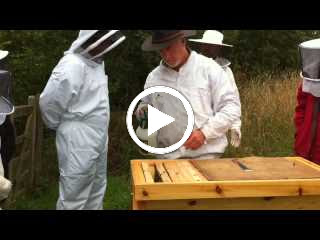
Video by Sheyne Bauermeister at the Yarner Trust, Welcombe, Devon. Phil Chandler demonstrating the use of a water spray as a substitute for smoke.
Monday, May 24, 2010
Swarming and Swarm Management
We are well into swarming season in the UK, much of Europe and the USA, so we are getting lots of swarm-related questions on the forum. This has prompted me to write an ebook dealing solely with the subject of swarming and swarm management from the point of view of 'barefoot beekeeping'.
You can find it at www.offthebookshelf.com along with a new-format edition of The Barefoot Beekeeper.
We want to hear your swarm stories on the forum - with pictures!
You can find it at www.offthebookshelf.com along with a new-format edition of The Barefoot Beekeeper.
We want to hear your swarm stories on the forum - with pictures!
Saturday, March 20, 2010
BBKA backed the wrong horse - but will they admit it?
New research from China has shown that synthetic pyrethroids - the same chemicals that we have been told to use in our hives against Varroa for the last 30 years, and the same chemicals that the British Bee Keepers Association cheerfully endorse as 'bee friendly' - are in fact toxic to bees and it has now been shown that 'the hatch rate of pyrethroid-exposed eggs was significantly depressed'.
This immediately raises the questions: why was this research not done BEFORE we were told to use them in our hives. And if it was done, how were the manufacturers allowed to fudge and/or conceal the results for so long?
Is it because - in the words of Dr L R B Mann, who was for 12 years advisor on toxins to the New Zealand Ministry of Health, "the chemical industry is, as an historical tendency, a refuge for crooks"?
Link to article: Widely Used Pesticides Found to Impair Bee Reproduction http://tinyurl.com/yzm2let
Link to article: High Levels of Miticides and Agrochemicals in North American Apiaries: Implications for Honey Bee Health http://tinyurl.com/yg2gssg
This immediately raises the questions: why was this research not done BEFORE we were told to use them in our hives. And if it was done, how were the manufacturers allowed to fudge and/or conceal the results for so long?
Is it because - in the words of Dr L R B Mann, who was for 12 years advisor on toxins to the New Zealand Ministry of Health, "the chemical industry is, as an historical tendency, a refuge for crooks"?
Link to article: Widely Used Pesticides Found to Impair Bee Reproduction http://tinyurl.com/yzm2let
Link to article: High Levels of Miticides and Agrochemicals in North American Apiaries: Implications for Honey Bee Health http://tinyurl.com/yg2gssg
Friday, March 19, 2010
Widely Used Pesticides Found to Impair Bee Reproduction
Posted: March 8, 2010
By Janet Raloff, for Science News' Science & the Public Blog
Pesticides are agents designed to rid targeted portions of the human environment of undesirable critters – such as boll weevils, roaches or carpenter ants. They’re not supposed to harm beneficials. Like bees. Yet a new study from China finds that two widely used pyrethroid pesticides – chemicals that are rather “green” as bug killers go – can significantly impair the pollinators’ reproduction.
Click here to find out more!
Both chemicals are widely used in North America and elsewhere, including China. And, the researchers point out, the concentration of each pesticide that produced adverse effects in the experiments was at or below those that bees could encounter while pollinating treated crop fields.
In recent years, there’s been a big move by U.S. farmers to turn away from broad-spectrum potent bug killers to the more targeted and environmentally friendly pyrethroids. These synthetic chemicals have been fashioned after the natural pyrethrin bug deterrent in chrysanthemums.
The authors of the new study don’t argue that pyrethroids are a cause of colony collapse disorder, the mysterious die-offs affecting honeybees throughout North America. But they do argue that their findings suggest further investigation is warranted to confirm whether these immensely popular crop-protection chemicals might prove a previously unrecognized threat to pollinators. The source of a double-whammy, if you will, for already hammered bees.
Ping-Li Dai of the Chinese Academy of Agricultural Science and the Ministry of Agriculture led a team of researchers at those Beijing institutions together with a physiologist from the Second Military Medical University in Shanghai. The team investigated sublethal effects of bifenthrin and deltamethrin. Bifenthrin is used to kill everything from termites around homes to fire ants, corn pests and the mites that attack fruit trees. Deltamethrin is targeted at aphids, mealy bugs, whitefly, fruit moths, caterpillars on field crops, roaches, horseflies, mosquitoes and fleas.
After first establishing the dose that would kill no more than five percent of exposed bees, the researchers laced sugar water near bee hives with either of the pyrethroids at that tolerable dose. Worker bees had access for 20 days to the pseudo-nectar in each of three successive years. Queens in each colony were dosed every five days over each treatment period. Studied bees had no access to outside nectar during the trial periods.
Compared to queens receiving clean sugar water, those in the pyrethroid groups were substantially less fecund. For instance, clean queens in 2006 laid a little more than 1,200 eggs each day, compared to not quite 900 a day in the bifenthrin group and roughly 600 per day in the deltamethrin group. In general, the weight of eggs laid was higher in the pyrethroid-treated hives, but the hatch rate of pyrethroid-exposed eggs was significantly depressed. It varied by year, but in 2008, for instance, 88 percent of eggs in the control hives hatched versus 71.4 percent of those in the bifenthrin-treated hives and 80.5 percent of the deltamethrin-treated bees.
The success rate of hatchlings, that is the share that reached adulthood, varied from 75 to 95 percent in the control hive – making it between 20 and 40 percentage points higher than in hives where bees had been exposed to a pyrethroid. Dai and colleagues report their findings in the March Environmental Toxicology & Chemistry.
The bottom line, Dai’s team concludes: “The impact of pesticides on the colony may be severe.”
And the researchers concede that they can only guess at how severe because their paper focused on easily quantifiable, gross effects. Both pyrethroids are neurotoxic, typically causing paralysis and worse in target pests. The Chinese scientists didn’t investigate whether in-egg or juvenile exposures to the pesticides might have resulted in behavioral impacts during adulthood. Perhaps diminishing the bees’ ability to learn tasks or remember where good nectar sources were.
As I pointed out in a story four years back, pyrethroids may be relatively green – but they’re not totally benign to non-target organisms. That story was about little aquatic midges and other sediment dwellers. Essentially the food for fish and other critters people really care about.
Now we see threats to bees. And that should give all of us pause – because these unsung heroes of the farm make much of today’s bountiful harvests possible.
---------------------------------------------------------------------
Now let me see, those pesticides that the BBKA endorse as being 'bee-friendly', aren't they pyrethroids?
And those strips they have been telling beekeepers to put in their hive to kill varroa, aren't they also pyrethroids?
So I wonder why this research was left to the Chinese to do?
WHY DIDN'T THEY DO THE RESEARCH BEFORE TELLING US THIS STUFF IS HARMLESS?
By Janet Raloff, for Science News' Science & the Public Blog
Pesticides are agents designed to rid targeted portions of the human environment of undesirable critters – such as boll weevils, roaches or carpenter ants. They’re not supposed to harm beneficials. Like bees. Yet a new study from China finds that two widely used pyrethroid pesticides – chemicals that are rather “green” as bug killers go – can significantly impair the pollinators’ reproduction.
Click here to find out more!
Both chemicals are widely used in North America and elsewhere, including China. And, the researchers point out, the concentration of each pesticide that produced adverse effects in the experiments was at or below those that bees could encounter while pollinating treated crop fields.
In recent years, there’s been a big move by U.S. farmers to turn away from broad-spectrum potent bug killers to the more targeted and environmentally friendly pyrethroids. These synthetic chemicals have been fashioned after the natural pyrethrin bug deterrent in chrysanthemums.
The authors of the new study don’t argue that pyrethroids are a cause of colony collapse disorder, the mysterious die-offs affecting honeybees throughout North America. But they do argue that their findings suggest further investigation is warranted to confirm whether these immensely popular crop-protection chemicals might prove a previously unrecognized threat to pollinators. The source of a double-whammy, if you will, for already hammered bees.
Ping-Li Dai of the Chinese Academy of Agricultural Science and the Ministry of Agriculture led a team of researchers at those Beijing institutions together with a physiologist from the Second Military Medical University in Shanghai. The team investigated sublethal effects of bifenthrin and deltamethrin. Bifenthrin is used to kill everything from termites around homes to fire ants, corn pests and the mites that attack fruit trees. Deltamethrin is targeted at aphids, mealy bugs, whitefly, fruit moths, caterpillars on field crops, roaches, horseflies, mosquitoes and fleas.
After first establishing the dose that would kill no more than five percent of exposed bees, the researchers laced sugar water near bee hives with either of the pyrethroids at that tolerable dose. Worker bees had access for 20 days to the pseudo-nectar in each of three successive years. Queens in each colony were dosed every five days over each treatment period. Studied bees had no access to outside nectar during the trial periods.
Compared to queens receiving clean sugar water, those in the pyrethroid groups were substantially less fecund. For instance, clean queens in 2006 laid a little more than 1,200 eggs each day, compared to not quite 900 a day in the bifenthrin group and roughly 600 per day in the deltamethrin group. In general, the weight of eggs laid was higher in the pyrethroid-treated hives, but the hatch rate of pyrethroid-exposed eggs was significantly depressed. It varied by year, but in 2008, for instance, 88 percent of eggs in the control hives hatched versus 71.4 percent of those in the bifenthrin-treated hives and 80.5 percent of the deltamethrin-treated bees.
The success rate of hatchlings, that is the share that reached adulthood, varied from 75 to 95 percent in the control hive – making it between 20 and 40 percentage points higher than in hives where bees had been exposed to a pyrethroid. Dai and colleagues report their findings in the March Environmental Toxicology & Chemistry.
The bottom line, Dai’s team concludes: “The impact of pesticides on the colony may be severe.”
And the researchers concede that they can only guess at how severe because their paper focused on easily quantifiable, gross effects. Both pyrethroids are neurotoxic, typically causing paralysis and worse in target pests. The Chinese scientists didn’t investigate whether in-egg or juvenile exposures to the pesticides might have resulted in behavioral impacts during adulthood. Perhaps diminishing the bees’ ability to learn tasks or remember where good nectar sources were.
As I pointed out in a story four years back, pyrethroids may be relatively green – but they’re not totally benign to non-target organisms. That story was about little aquatic midges and other sediment dwellers. Essentially the food for fish and other critters people really care about.
Now we see threats to bees. And that should give all of us pause – because these unsung heroes of the farm make much of today’s bountiful harvests possible.
---------------------------------------------------------------------
Now let me see, those pesticides that the BBKA endorse as being 'bee-friendly', aren't they pyrethroids?
And those strips they have been telling beekeepers to put in their hive to kill varroa, aren't they also pyrethroids?
So I wonder why this research was left to the Chinese to do?
WHY DIDN'T THEY DO THE RESEARCH BEFORE TELLING US THIS STUFF IS HARMLESS?
Monday, March 08, 2010
Saturday, March 06, 2010
Stupid Beekeepers: a real cause of bee decline?
Are some beekeepers and breeders largely responsible for many of the disease and pest problems besetting our bees?
My latest podcast suggests that far too many queens are imported into Britain and that new beekeepers are getting conned into buying packages when they thought they were buying nucs.
Over 10,000 queen bees were brought into Britain in 2009. Over 100,000 were imported into Canada. Is it surprising that our hives are now full of exotic pests and viruses - and how much worse will it get before we see sense and ban imports?
Podcast site
The Barefoot Beekeeper on iTunes
My latest podcast suggests that far too many queens are imported into Britain and that new beekeepers are getting conned into buying packages when they thought they were buying nucs.
Over 10,000 queen bees were brought into Britain in 2009. Over 100,000 were imported into Canada. Is it surprising that our hives are now full of exotic pests and viruses - and how much worse will it get before we see sense and ban imports?
Podcast site
The Barefoot Beekeeper on iTunes
Wednesday, February 10, 2010
Introduction to Natural Beekeeping
Mindful that many of the people attending my weekend events and talks may not have a clear idea of what 'natural beekeeping' means, I have put together an article setting out my personal take on natural beekeeping downloadable in just about every common format. You should be able to read it on almost any piece of wired hardware you may have lying around - so let me know what you think.
Monday, February 08, 2010
Thursday, February 04, 2010
Barefoot Beekeeper Podcast launched
Having thought about it for a while, I have taken the plunge and started a Barefoot Beekeeper Podcast.
I'm still trying to work out why I find it easier to talk to a live audience than a microphone, so forgive me if there are a few 'ums and ahs' that I missed during editing.
I hope to record a new podcast about every two weeks, but it will depend on the feedback I get. Do you prefer to read or to listen? Let me know on my new FaceBook page (search for Barefoot Beekeeper) and follow me on Twitter (BarefootBee).
I'm still trying to work out why I find it easier to talk to a live audience than a microphone, so forgive me if there are a few 'ums and ahs' that I missed during editing.
I hope to record a new podcast about every two weeks, but it will depend on the feedback I get. Do you prefer to read or to listen? Let me know on my new FaceBook page (search for Barefoot Beekeeper) and follow me on Twitter (BarefootBee).
Monday, December 07, 2009
BBKA ex-president attacks Friends of the Bees
Glyn Davies, who was president of the BBKA when they made the secret deal with Syngenta and Bayer around 2000-2001, and who organized the GM propaganda exercise at BBKA HQ in 2002, has attacked both me and Friends of the Bees in his editorial for the latest Devon BKA county journal 'Beekeeping'. Some consider this an abuse of his position as editor.
You can read it as a scan here.
He says that he was 'very disappointed...to receive an angry email... which rather churlishly (sic) condemned Syngenta... for announcing a major investment in research into the declining population of honeybees. It is better that Syngenta does not further research the possible role of its own pesticides. Others are independently.'
Oh really - who is that, then?
He goes on to describe Friends of the bees as sounding 'cosy and well-intentioned' but that it aims 'to deprive bees of the treatments and medicines they need to help them overcome the pests and pathogens that modern trade and transport have spread around.'
Apparently he sees the application of natural principles as 'deprivation'. And it is largely the beekeeping industry that has spread them around, with the support of the BBKA who have never condemned the practice of importing queens.
He goes on 'The exposed hatred in the email for the entire agrochemical industry shows that the core concerns of the writer are more political to the point of religion than apicultural.'
Well, Glyn, it's hard for me to show any respect for an industry that has done so much damage to the planet, its people and its animals. And religion is not something I suffer from.
I take it as a sign that we are having an impact on people's thinking about bees in the context of our toxic agricultural system when someone with such a big axe to grind starts attacking us in public - and simultaneously exposes his own prejudices and ignorance.
Being savaged by a dead sheep comes to mind.
You can read it as a scan here.
He says that he was 'very disappointed...to receive an angry email... which rather churlishly (sic) condemned Syngenta... for announcing a major investment in research into the declining population of honeybees. It is better that Syngenta does not further research the possible role of its own pesticides. Others are independently.'
Oh really - who is that, then?
He goes on to describe Friends of the bees as sounding 'cosy and well-intentioned' but that it aims 'to deprive bees of the treatments and medicines they need to help them overcome the pests and pathogens that modern trade and transport have spread around.'
Apparently he sees the application of natural principles as 'deprivation'. And it is largely the beekeeping industry that has spread them around, with the support of the BBKA who have never condemned the practice of importing queens.
He goes on 'The exposed hatred in the email for the entire agrochemical industry shows that the core concerns of the writer are more political to the point of religion than apicultural.'
Well, Glyn, it's hard for me to show any respect for an industry that has done so much damage to the planet, its people and its animals. And religion is not something I suffer from.
I take it as a sign that we are having an impact on people's thinking about bees in the context of our toxic agricultural system when someone with such a big axe to grind starts attacking us in public - and simultaneously exposes his own prejudices and ignorance.
Being savaged by a dead sheep comes to mind.
Subscribe to:
Posts (Atom)